
Dr. Frank McCormick: Leading the Drive for RAS
Dr. McCormick has dedicated his career to characterizing how RAS genes and related proteins drive cancer growth. His work clarifying how KRAS mutations alter RAS signaling helped lay the foundation for the first targeted therapies against this common cancer driver.
Looking back at his childhood in the tiny rural village of Duckhole, England, Frank McCormick, PhD, FAACR, the founding director of the University of California, San Francisco (UCSF) Helen Diller Family Comprehensive Cancer Center, remembers a strict high school that had a “learn or leave” motto and prized discipline and order. But there was a glimmer of light during Dr. McCormick’s stifling school days—a 10th-grade chemistry teacher who wisely predicted that the study of biochemistry would be the future.
The young Dr. McCormick spent his time outdoors, observing the animals, fish, plants, and the vibrant ecosystems in ponds and rivers surrounding his rural home. He honed a scientist’s ability to observe details and changes that conveyed broader biological complexity. “I spent a lot of time just observing nature and getting a feel for biology as a young boy,” he said.
Eager to see the larger ecosystem of the world, Dr. McCormick was 17 years old when he left England for the first time and joined Voluntary Service Overseas, a non-governmental organization and charity that sent skilled workers to volunteer in underserved communities. In 1967, Dr. McCormick went to Ghana to teach math and science at a boys’ school in a small village in the West African country. “It taught me a lot about African history but also different aspects of culture and time,” he said. “I was completely isolated from everybody at home with no telephone or other technological connections.”
Dr. McCormick returned to England in 1968 to pursue his studies. He received a bachelor’s degree in biochemistry from the University of Birmingham in 1972 and earned a doctorate in biochemistry from Cambridge University, where he spent time in a lab studying mammalian cells infected with viruses. “In the United Kingdom, you have three years to get your PhD and get out. It’s a pretty high-throughput system. I was only 25 and had already received my doctorate,” he said.
The Era of Molecular Biology and Oncogenes
Dr. McCormick’s postdoctoral studies took him to the United States, where he immersed himself in molecular biology at the State University of New York at Stony Brook. He became caught up in the excitement of technologies that allowed scientists to identify genes and proteins, especially in cancer. He then went back to the U.K. for a second postdoctoral fellowship at the Imperial Cancer Research Fund in London, then a hotbed for molecular oncology.
As part of a laboratory collaboration, Dr. McCormick spent a year at the University of California, Berkeley. At the time, little was known about how viruses turned normal cells into cancerous ones, or the role of a protein now known as p53 in the process. In a study, published in Nature in 1981, Dr. McCormick showed elevated levels of this protein in virus-transformed mouse cells. This finding helped launch decades of research that would eventually reveal p53’s function as a tumor suppressor.
In California, Dr. McCormick witnessed the biotechnology revolution firsthand as companies developed tools that allowed scientists to clone DNA and combine genetic material from different species into recombinant DNA molecules. Genentech, founded in 1976 in San Francisco, used this technology to produce human insulin from bacteria, creating a large-scale method to make a key protein for treating diabetes.
“California is where I sort of took root,” Dr. McCormick said. “In 1980, the biotech revolution was just starting. Genentech went public as a biotechnology company, and there were lots of jobs and lots of excitement around biotechnology. I decided to stay and be a part of it.”
In 1981, Dr. McCormick became the head of research at the Berkeley-based biotechnology company Cetus Corp., which was working with gene cloning—a technology only invented the year before. At Cetus, Dr. McCormick worked alongside biochemist Kary Mullis, who invented the polymerase chain reaction (PCR) in 1983. Using PCR, researchers could make millions of copies of DNA in just hours, which allowed them to study DNA and its structure. Mullis later won the Nobel Prize in Chemistry in 1993 for this groundbreaking work that revolutionized molecular biology.
At this time, researchers had already suspected that the RAS gene family were oncogenes—genes that can cause cancer when mutated. In 1982, which is often called “the year of the oncogene,” research groups showed that mutations in RAS genes could transform normal cells in culture, and a RAS mutation, called HRAS, was soon identified in human bladder cells. Subsequent studies showed that a single amino acid change in the 188-amino acid human KRAS protein, a key member of the RAS family, could convert a normal functioning cell into cancer.
Stunned by the knowledge that a single amino acid change could confer such a transformation, Dr. McCormick pivoted to study the RAS gene. In 1985, Dr. McCormick was a co-author of a study that showed antibodies could attach to the abnormal RAS protein and temporarily reverse its cancer-like effects in cells. Two years later, Dr. McCormick and his colleagues further characterized biochemical differences between normal and mutated RAS proteins. His search for small molecules that might inhibit this activity became even more urgent in 1988, when researchers discovered that KRAS mutations are present in the majority of pancreatic cancers and serve as key drivers of the disease.
Focusing on Targeted Cancer Therapies
In 1992, Dr. McCormick founded San Francisco-based Onyx Therapeutics to develop drugs that target cancer-causing proteins. Choosing which oncogene to explore was easy for McCormick. “RAS was my favorite because it was found in so many cancers,” he said.
But RAS proved a formidable foe, and its complexity caused the company to shift its focus to target RAF, which is a protein activated by RAS that results in uncontrolled cancer cell growth. RAF proteins are considered protein kinases, enzymes that control cellular growth and metabolism. At the time, many scientists believed it was impossible to develop drugs that could selectively target protein kinases with the precision needed for effective therapy. However, that changed in May 2001, when the Food and Drug Administration (FDA) approved the first kinase inhibitor, imatinib (Gleevec), to treat chronic myeloid leukemia.
Dr. McCormick’s work at Onyx Therapeutics led to the clinical development of sorafenib (Nexavar), a kinase inhibitor that targets mutated RAF but also binds to and blocks other protein kinases. The FDA approved the drug first in 2005 for kidney cancer and later as a treatment for liver and thyroid cancers.
As Onyx Therapeutics brought sorafenib and other molecules into cancer clinical trials, Dr. McCormick began to look for his next challenge. In 1997, he started his own laboratory at UCSF and became the first director of the UCSF Helen Diller Family Comprehensive Cancer Center. Having not yet succeeded in developing a small molecule that could target RAS, he focused on why RAS proteins were so difficult to inhibit. Unlike RAF, RAS is not a protein kinase. Rather, the protein is a GTPase—a molecular switch that toggles between inactive and active states within the membrane of a cell to activate downstream protein kinases.
His lab mapped RAS signaling pathways in both normal and cancer cells and identified key proteins that could serve as potential targets for new cancer drugs. He showed that mutations in KRAS could lock the protein in its active state, resulting in continuous activation of the downstream pathway, which, in turn, could cause uncontrolled cell growth.
Cancer Research Stewardship
In 2011, Dr. McCormick was elected to serve as the President of the American Association for Cancer Research® (AACR) for 2012-2013. Since then, he has remained an integral figure within AACR. Dr. McCormick has served as a mentor for the AACR-Minority and Minority-Serving Institution Faculty-Scholar in Cancer Research Award program and was the chair of the AACR International Affairs Committee from 2016-2018.
“We have a Past President in him who continues to provide sage guidance to AACR, and we benefit greatly from his amazing intellect and his vision for the future of cancer research,” said Margaret Foti, PhD, MD (hc), the CEO of the AACR, who has known Dr. McCormick for decades.
AACR has provided a landscape of scientific discovery for researchers at all stages of their careers throughout the world, Dr. McCormick said. “The organization provides a cultural home for cancer researchers from all disciplines and has done so for many years. This continuity is especially important in a world of uncertainty. It provides encouragement and reminds cancer researchers of the critical importance of their work.”
At the AACR Annual Meeting each year, researchers, clinicians, industry professionals, cancer survivors, and patient advocates come together to share their work and learn from one another. “The Annual Meeting is the most important event of the year for thousands of researchers,” Dr. McCormick said. “They come to the meeting to receive a comprehensive update on advances in cancer research and to meet colleagues, plan collaborations, and build the networks that enrich the whole cancer research environment. AACR also supports more specialized meetings and provides direct funding to early-stage scientists and fellowships to later-stage investigators.”
In 2013, Harold Varmus, MD, then the director of the National Cancer Institute (NCI), tapped Dr. McCormick to lead the NCI-sponsored RAS Initiative at the Frederick National Laboratories for Cancer Research in Maryland. This initiative provides funding to researchers to identify ways to treat cancers driven by mutations in the RAS family of genes—now known to be drivers of about one-third of all human cancers. As part of that job, Dr. McCormick regularly traveled from California to Frederick, Maryland, one week a month for ten years, though he now travels less frequently.
Under Dr. McCormick’s leadership, the RAS Initiative, in conjunction with BridgeBio Oncology Therapeutics and the Lawrence Livermore National Laboratory, has yielded three molecules now in clinical trials, including BBO-11818, a so-called “pan-KRAS” inhibitor that can bind to and block several KRAS mutations. One molecule is currently being studied in a phase I clinical trial in people with KRAS-mutated tumors, including people with pancreatic and lung cancers.
The evolving landscape of RAS continues to enthrall Dr. McCormick. “It turns out that the regulation is very different from the textbook version, and using technology and tools which didn’t exist when the pathway was first characterized, we are now rewriting the textbook of how RAS proteins are regulated,” he said.
Dr. McCormick is also studying ways to target mutated RAS with small molecules as a cancer prevention strategy, aiming to stop cancer precursor cells from developing into cancer. “The idea is that if you intervene early enough when there is only a very small number of [pre-cancer or cancer] cells that don’t have much heterogeneity or a lot of other mutations, you should be able to stop the cancer development in its tracks much more efficiently than [if you] wait until it’s a full-blown tumor mass with hundreds of other mutations and subclones and pre-existing resistance mutations,” he said.
Dr. McCormick still draws inspiration from his time teaching in Ghana after high school. “The boys I taught were all highly motivated and a really great group of young men,” he said. “It was an experience that stayed with me because I realized that these people were talented and would have done very well at university if they had had the opportunity.” Dr. McCormick supports a program that brings students from West Africa to his alma mater, the University of Birmingham, to study and receive a degree with the option of staying for graduate school in the U.K. or going back to West Africa to pursue a career in science, if desired. “It is a structured program that allows these students to now be part of a system in which they receive support and an education, and are exposed to new opportunities,” he said. “There is so much talent, energy, and creativity in people that should be realized.”
Tying back to these efforts in Africa, Dr. McCormick was part of AACR’s Africa Regional Advisory Group and helped organize AACR’s New Frontiers in Cancer Research conference in Cape Town, South Africa, in 2017. He also continues to help organize educational and translational AACR meetings on RAS. “When you get involved with the AACR, you’re part of AACR for life,” he said. “It is a major part of my cancer research life and an important interactive community that continues to drive cancer research.”
Life in the Fast Lane
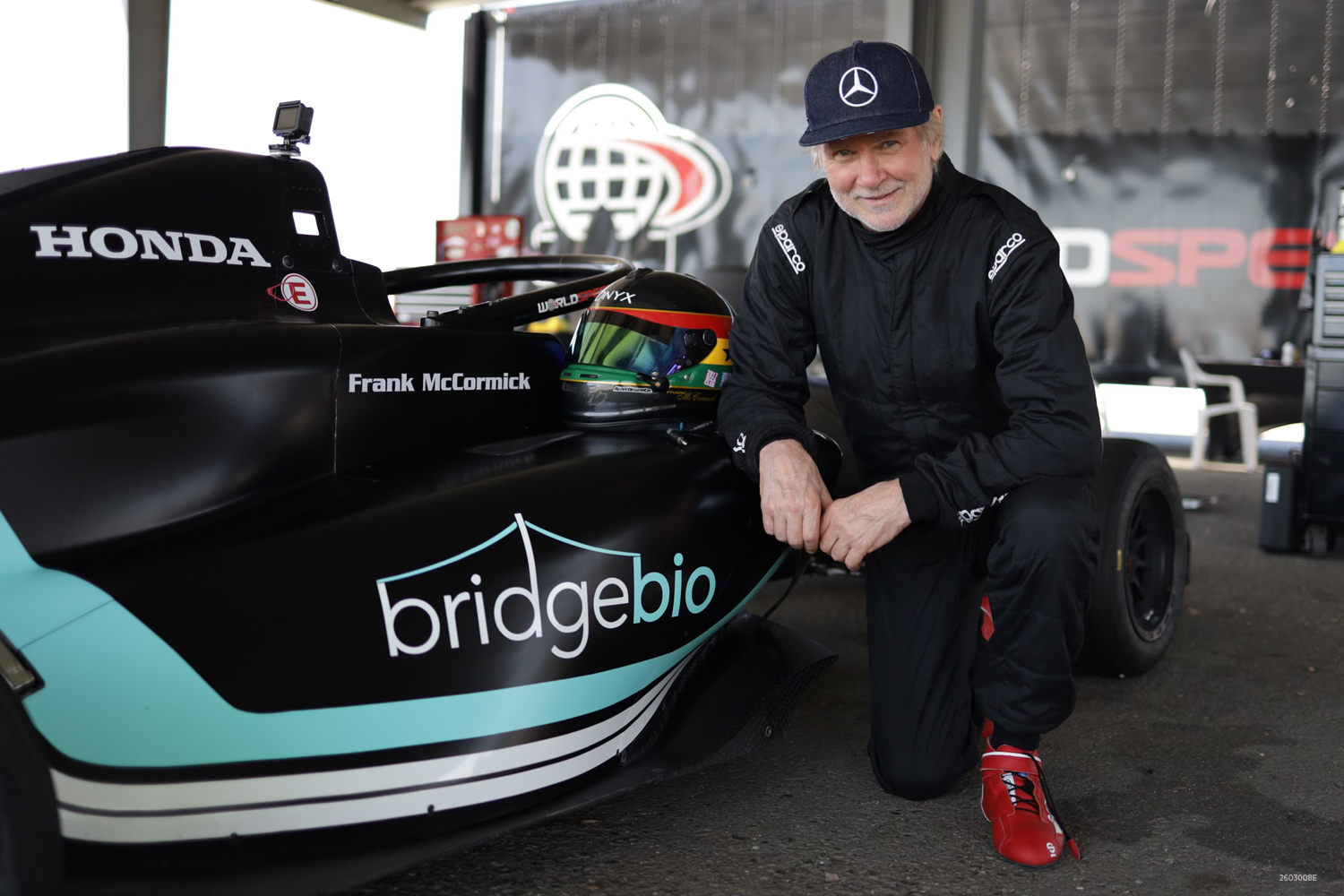
On most weekends, Frank McCormick, PhD, FAACR, can be found far from his laboratory at the University of California, San Francisco—on auto racing tracks near his home, such as Sonoma Raceway and Laguna Seca Raceway. Dr. McCormick took up the sport in 1991 after moving to California, and it has become a major part of his life.

“It’s kind of addictive. The excitement of racing is really something special. It’s a good break from science—being around completely different people who have a very different culture and different backgrounds. It’s a refreshing way to experience life and travel around the country competing,” he said. “My dad was an engineer, and he built his own race car, and he took me to races sometimes, so I always had a passing interest in racing.
“It’s very physical, technical, and exciting,” he said. “Everybody loves being on the racetrack, even people who don’t know they’ll like it. Once you get a car on a track, you feel it’s a whole new experience.” Dr. McCormick now owns a racing team in Sonoma, for which he used to race. He still gets behind the wheel to practice, but he has not been in a competitive race for about a year.
Telo Stewart of World Speed Motorsports first met Dr. McCormick in 1997 as a mechanic on his race car. He said that Dr. McCormick was known as the “iron man” on the track. “He would run more laps than anyone,” Stewart said. “Most people would get worn out. He would do this rain or shine and on all types of tracks. He has always been impressive with his stamina, dedication, and ability on track.”
But for Stewart, what stands out the most about Dr. McCormick is his personality as a team member. “He always finds a way in situations that get most people down to make light of the situation and keep us from taking ourselves too seriously,” he said.
Dr. McCormick’s persistence, humor, and extraordinary personality are also traits that drive his pursuit of science, according to Margaret Foti, PhD, MD, (hc), the CEO of the AACR. “We are all blessed to have such a special colleague. Because he is so very energetic and innovative, he excites everyone around him so they can reach their potential,” she said.
Related Posts