
AACR Donors and Partners
United for Cancer Research
Agilent, a global leader in life sciences, diagnostics, and applied markets with a team of approximately 18,000 employees worldwide, recently partnered with the American Association for Cancer Research® (AACR) to support academic cancer researchers during this time of critical funding challenges.
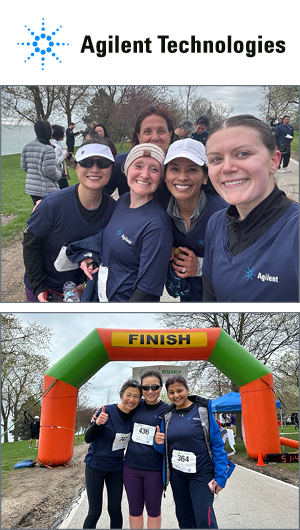
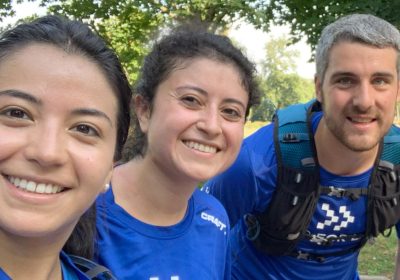
From October 4-11, 2025, Agilent invited employees, customers, partners, families, and friends to “lace up, show up, and stand up for science” with a 5K run/walk. Participants created teams in their local communities, through Agilent office sites, and virtually, logging steps and collecting contributions. Funds raised through this event will be used to support the AACR Scholar-in-Training Awards program, which helps shape the future of cancer prevention and treatment by enabling early-career scientists to present their innovative work at the AACR Annual Meeting. All donations from employees were doubled, thanks to the Agilent Foundation Matching Gifts Program.
“Coordinating the Agilent Cancer Research 5K was an inspiring experience,” said Teara Stickley, marketing program manager, Americas at Agilent Technologies. “Seeing our global community unite for science and share powerful stories reminded me why we run: to support cancer research and each other. I’m proud of the Agilent team, including our planning leads, organizing members, and every runner who showed up with heart, and I’m grateful for the partnership with AACR. We’re excited to build on this momentum and look forward to the AACR 2026 event, continuing our commitment to a future without cancer.”
All participants also were recognized with commemorative race medals, with special awards for team spirit, social media promotion, top performance, and top fundraising.
A total of 170 participants, representing 22 teams, raised more than $23,000 for AACR with this event. Thank you to Agilent, and everyone who came together to move cancer research forward, one stride at a time.
Joining Forces for Chemistry-focused Research
 The Mark Foundation for Cancer Research and theAmerican Association for Cancer Research® (AACR) are proud to announce the launch of the AACR-Mark Foundation Chemistry in Cancer Research Grants. This grant mechanism seeks to support chemists pursuing impactful, groundbreaking basic or translational research projects that utilize chemistry or chemical biology to address urgent issues in cancer.
The new AACR-Mark Foundation Chemistry in Cancer Research Grants are designed to help researchers take on major contemporary challenges in the field, with each funded investigator receiving $435,000 to support their projects. The 2026 program will fund transformative research in areas such as chemical biology, drug discovery, and the development of novel therapeutic modalities and drug delivery systems, aiming to harness the power of chemistry to create new breakthroughs for cancer patients.

This new program builds on a longstanding collaboration between the two organizations to drive progress against cancer. The initiative grew from discussions within the AACR’s Chemistry in Cancer Research (CICR) Working Group, of which The Mark Foundation’s CEO, Ryan Schoenfeld, is a member. Schoenfeld, a chemist by training, and his fellow CICR members identified a critical need for more funding opportunities that encourage chemists to think about how to apply their work to cancer and strengthen the community of chemists and chemical biologists tackling the biggest challenges in cancer research.
“Some of the most critical unanswered questions in cancer are, at their core, chemistry problems,” said Schoenfeld. “This grant program is a direct investment in the chemists who can solve them. By bringing their unique tools and perspectives to the forefront of oncology research, we can accelerate the discovery of the next generation of treatments that will deliver improved outcomes for cancer patients.”
Related Posts